- 1Movie Overview
- 2Direction & Cinematography
- 3Cast & Performances
- 4Character Psychology
- 5Themes & Emotional Depth
- 6Memorable Scenes & Dialogue
- 7The Ending — Does It Deliver?
- 8What Works
- 9Honest Criticism
- 10How It Compares
- 11Legacy & Cultural Impact
- 12Behind the Scenes
- 13Who Should Watch It?
- 14Final Verdict
- Genre: Drama, TV Movie
- Director: Allan Moyle
- Year: 2004
- Runtime: 1h 25m
- Language: English (EN)
- TMDB Rating: ⭐ 6.3/10
Movie Overview
How do you tell the story of one of the 20th century's most complicated figures in under 90 minutes on a TV budget? The answer, as Man in the Mirror: The Michael Jackson Story shows, is that you don't. You create a highlight reel, a frantic sprint from The Jackson 5's early days under the tyrannical hand of Joe Jackson to the superstardom of Thriller and the public fallout from the 1993 child abuse allegations.
The film hits all the expected narrative beats. We see a young Michael, tormented by his father. We see the creative spark for "Billie Jean." We see the Pepsi commercial accident, the construction of Neverland, and his marriage to Lisa Marie Presley. But these events aren't connected by any psychological tissue; they are simply checked off a list.
There's no build, no sense of cause and effect. One minute Michael is a global icon, the next he's a recluse building a fantasy land. The film offers the simplest explanation possible for everything: his father broke him, and fame kept him broken. It's a tragedy told without any of the weight tragedy requires.
And it never, ever slows down.
Direction & Cinematography
Director Allan Moyle made his name with scrappy, authentic films like *Pump Up the Volume* and *Empire Records*, which makes his work on *Man in the Mirror* all the more baffling. The direction here is pure, uninspired television fare. Scenes are composed of functional medium shots and shot-reverse-shot conversations that feel devoid of any artistic point of view. It's visually flat, as if the only goal was to get the scene in the can and move on.
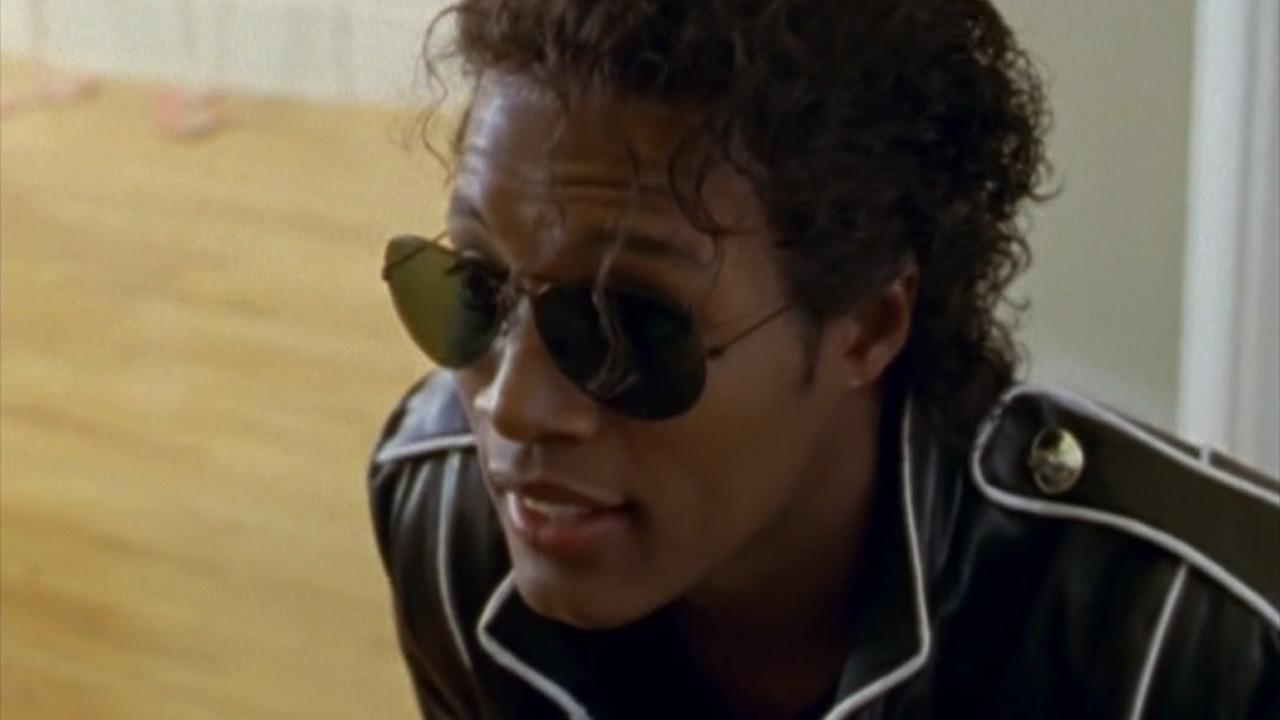
What surprised me most was how lifeless the musical numbers are. During the Motown 25 sequence, where Jackson debuted the moonwalk, the camera stays in a tight, stable shot on Flex Alexander. There are maybe 20 extras in the 'crowd.' There's no energy, no sense of a momentous event unfolding. It feels like a dress rehearsal, not a defining moment in pop culture history. Moyle’s direction seems less interested in capturing the feeling of these events than in simply documenting that they happened.
And the pacing is a disaster. By trying to cover three decades, the film jumps years at a time, leaving the viewer with whiplash. Personally, I think a tighter focus on a single era would have served the story far better than this breathless, superficial summary.
Cast & Performances
Flex Alexander, a performer known more for TV comedy, was given an impossible task in *Man in the Mirror*. I'll admit I didn't expect a perfect impersonation, but his performance is a strange mix of diligent mimicry and dramatic hollowness. He gets some of the physicality down—the spins, the posture—but in dialogue scenes, he's lost. He adopts a whispery, high-pitched voice that becomes a caricature, failing to find the man behind the mannerisms. When he's supposed to be conveying deep pain or paranoia, his face is mostly a blank slate.
Eugene Clark as Joe Jackson is a one-note monster. He spends the entire movie either scowling or yelling, a cartoon villain with no other discernible traits. There's no attempt to understand what drove him beyond simple greed and cruelty, which makes his impact on Michael feel schematic rather than genuinely traumatic.
It bothered me slightly that none of the supporting players register at all. Diana Ross, Quincy Jones, and Lisa Marie Presley are present as names and functions, but the actors playing them have so little screen time and such weak material that they barely make an impression. They exist only to move Michael's story from one point to the next.
Character Psychology
Michael's stated want is simple: to be loved, to be the greatest entertainer in the world, and to recapture a childhood that was stolen from him. The entire Neverland project is portrayed as a desperate, literal attempt to build a fantasy refuge from the traumas inflicted by his father and the pressures of his fame.
But what he actually needs—genuine human connection outside the bubble of celebrity and an honest reckoning with his past—is something the film is completely unequipped to explore. He remains a prisoner of his own success, and the script shows no interest in whether he is aware of his own psychological traps.
Themes & Emotional Depth
The film's most obvious theme is the corrosive effect of fame, especially when applied to a child star. It paints a picture of a man so isolated by his celebrity that he can no longer function in the real world. This is most evident in the scenes at Neverland, where Michael surrounds himself with children and amusements. The film presents this not as predatory, but as a sad, pathetic attempt to heal a wound that will never close.
Beneath that is a thread about the inescapable gravity of family trauma. No matter how many records Michael sells or how far he runs, he can't escape the shadow of his father. What stayed with me after the credits was the bleak idea that his entire life was a reaction to one man's cruelty, a cycle of pain replayed on a global stage.
Memorable Scenes & Dialogue
One moment that sticks out is the reenactment of the 'Billie Jean' video shoot. Flex Alexander is decked out in the costume, and the glowing pavement squares are there, but the sequence is shot with such flat lighting and inert staging that it has none ofthe original's magic. It's memorable for how completely it fails to capture the source, feeling more like a fan film than a professional production.
Another key scene involves the first meeting with the boy from the 1993 allegations. The film handles this with incredible clumsiness. The dialogue is purely defensive, with Jackson portrayed as a naive innocent and the family as opportunistic. That scene didn't land for me because it felt less like a dramatic exploration and more like a PR statement, sidestepping any difficult questions in favor of a simplistic, sanitized version of events.
The Ending — Does It Deliver?
The film rushes toward its conclusion: the fallout and legal battle of the 1993 allegations. The final act devolves into a series of hasty scenes depicting meetings with lawyers and the eventual settlement. It doesn't feel earned because the preceding 70 minutes did such a poor job building a coherent character. We're just told he's innocent and the whole thing is a shakedown, with no room for ambiguity.
I kept waiting for a moment of genuine introspection or a final, telling character beat, but it never came. The ending, which shows Jackson retreating further into isolation, feels perfunctory. It left me feeling empty and a little frustrated, as if I'd just watched a long, poorly edited news report rather than a film.
What Works
If I'm being generous, Flex Alexander's physical commitment is visible. He clearly studied Jackson's dance moves and on-stage body language, and for brief moments in the concert scenes, the impersonation is almost convincing. Using Michael Jackson's actual vocal tracks was the right call; any attempt by an actor to sing would have been an immediate disaster. It's the one element that provides a flicker of the real artist's energy, even if the visuals can't match it.
Honest Criticism
The screenplay is the film's mortal wound. It's a rushed, superficial checklist of major life events that offers no insight or depth. The production values are distractingly poor, from the terrible wigs to the sparsely populated concert scenes that look like they were filmed in a high school auditorium. Finally, the film's refusal to engage with any of the complexity or controversy of its subject makes it feel both cowardly and pointless.
How It Compares
The most obvious point of comparison is *The Jacksons: An American Dream* (1992). That miniseries, while also a TV production, had the runtime and focus to give the family's story real weight and character development. It's a far superior film that actually invests you in the characters. *Man in the Mirror* feels like a cheap knock-off made to capitalize on scandal.
It also feels less exploitative, somehow, than the 2017 Lifetime movie *Searching for Neverland*, which focused on his final years. At least *Man in the Mirror* tries, however feebly, to cover the whole story. But both films share a fatal flaw: they are too timid to offer a real psychological perspective, opting for a defensive and superficial portrait.
Legacy & Cultural Impact
This film has no real legacy to speak of, other than as a cautionary tale for cheap, opportunistic biopics. Released on VH1, it was met with general indifference and is now mostly remembered by Michael Jackson fans as a particularly egregious example of a miscast and poorly executed project. It didn't win any awards, and it certainly didn't start any meaningful conversations. It simply came and went, a footnote produced to cash in on the media frenzy surrounding Jackson in the mid-2000s.
Behind the Scenes
The film was produced for VH1 and broadcast in 2004, a year before Michael Jackson's second, more publicized trial began, which explains its timely but opportunistic feel. Flex Alexander, cast in the lead, was almost exclusively known for his starring role in the UPN sitcom *One on One*, making his dramatic turn here a significant departure. The filmmakers were able to secure the rights to use Jackson's original recordings, which is why you hear his actual voice during the musical numbers, making the lip-syncing from Alexander particularly noticeable.
Who Should Watch It?
This movie is for die-hard fans of bad cinema or for Michael Jackson completists with a morbid sense of curiosity. If you enjoy watching ambitious failures, there's something to see here. Anyone looking for a thoughtful, well-crafted, or even competent biography of Michael Jackson should stay far, far away.
Final Verdict
This is a poorly made, uninspired, and ultimately forgettable TV movie. It fails as a drama, as a biography, and as a piece of entertainment. I'm giving it such a low score because it takes one of the most compelling and tragic stories in modern culture and renders it completely inert. Personally, I think its greatest sin isn't that it's bad, but that it's boring. Pass on this and watch a documentary instead.
More details, ratings, and cast information on IMDb, TMDB, Wikipedia.