- 1Movie Overview
- 2Direction & Cinematography
- 3Cast & Performances
- 4Character Psychology
- 5Themes & Emotional Depth
- 6Memorable Scenes & Dialogue
- 7The Ending — Does It Deliver?
- 8What Works
- 9Honest Criticism
- 10How It Compares
- 11Legacy & Cultural Impact
- 12Behind the Scenes
- 13Who Should Watch It?
- 14Final Verdict

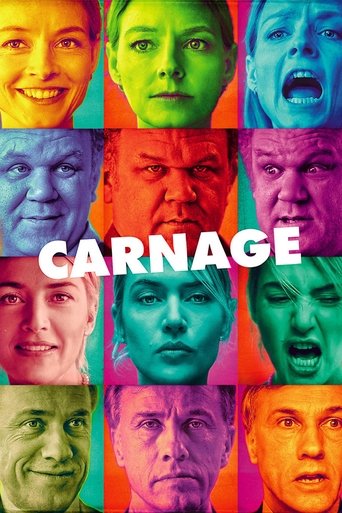
- Genre: Comedy, Drama
- Director: Roman Polanski
- Year: 2011
- Runtime: 1h 20m
- Language: English (EN)
- TMDB Rating: ⭐ 7.2/10
Movie Overview
Two Brooklyn couples meet cordially after their sons get into a playground fight. Penelope and Michael Longstreet (Foster and Reilly) host Nancy and Alan Cowan (Winslet and Waltz) for what should be a brief, civilized discussion about childhood conflict resolution. What starts with artisanal cobbler and careful diplomacy devolves into a full-scale war of manners, marriages, and repressed class resentment.
Polanski keeps the entire film within the Longstreets' apartment, heightening the claustrophobia as wine flows and masks slip. The first casualty is Penelope's prized art book, ruined by Nancy's sudden bout of vomiting — a moment that cracks the veneer of civility wide open.
What surprised me most was how quickly alliances shift. One minute Alan and Michael are bonding over scotch, the next Penelope and Nancy are united in disgust at their husbands' behavior. The real conflict isn't between the couples, but within them.
By the final act, these educated professionals are reduced to the same petty squabbling they're ostensibly there to resolve. The genius is we never see the kids' fight — only its mirror in the adults.
Direction & Cinematography
Polanski turns Yasmina Reza's play into a masterclass in controlled chaos. The camera moves like another guest at this disastrous gathering — sometimes politely observing from a corner, other times shoved into the middle of a shouting match. I noticed how often characters are framed in doorways, literally trapped by the architecture of their own lives.
That single location should feel limiting, but Polanski finds endless ways to recompose the space. Watch how the power dynamics shift simply by who's standing versus sitting, or which couple occupies the foreground. The direction creates this uneasy balance between farce and horror — it's funny until you recognize yourself in it.
But here's where Polanski's precision works against him slightly. At 80 minutes, the film barely overstays its welcome, yet I couldn't help feeling some exchanges were too theatrical, too perfectly timed. Real drunken meltdowns are messier.
Cast & Performances
Jodie Foster's Penelope is a tightly coiled spring of passive-aggressive liberalism. Watch how she 'accidentally' corrects Nancy's pronunciation of 'Tanzania' while serving her contaminated cobbler — that brittle smile never reaching her eyes. It's a performance that could tip into caricature, but Foster finds the real pain beneath the pretension.
Kate Winslet delivers the most physically committed work. Her vomiting scene is legendary (apparently achieved through intense diaphragm control), but what stayed with me was how she plays Nancy's gradual unraveling — that moment her designer shoes stick to the floor and something primal snaps.
Christoph Waltz and John C. Reilly have the trickier roles as the husbands. Waltz's Alan spends half the film on his cell phone, which should be annoying, but his deadpan delivery of 'I'm a fucking attorney' somehow becomes a running gag. Reilly fares slightly worse — his Michael never quite transcends the 'schlubby dad' archetype, though his breakdown over the hamster subplot is unexpectedly moving.
Character Psychology
Everyone here wants to be seen as the reasonable adult in the room. What they need is to admit they're just as childish as their kids. Penelope clings to her progressive ideals like armor, while Nancy's perfect hostess act crumbles under alcohol and stress.
The men are worse. Alan's workaholism is clearly a逃避 tactic, and Michael's folksy charm masks deep resentment. What's fascinating is watching them regress — by the end, they're practically the kids fighting in the park.
Themes & Emotional Depth
This is a film about the thin veneer of civilization. That art book Penelope treasures? It's just paper and ink once bodily fluids get involved. The characters use political correctness and bourgeois manners as weapons, revealing how quickly we revert to tribalism under stress.
What surprised me was how economic class becomes the unspoken fault line. The Cowans' Park Slope privilege versus the Longstreets' more modest means — it's all there in Michael's cheap scotch and Nancy's designer handbag. The real fight was never about the kids.
Memorable Scenes & Dialogue
Nancy's vomiting scene works because Winslet commits fully to the physical comedy — the way her body convulses, the horrified look on Foster's face, Waltz's clinical description of puke viscosity. It's gross and hilarious and perfectly timed.
Then there's the scotch-fueled confession scene where Michael admits throwing his daughter's hamster into the street. Reilly plays it with this weird mix of shame and defiance that makes you laugh and cringe simultaneously.
The final shot of the two couples silently sharing the elevator down gets me every time. After all that carnage, they still have to ride down together — a perfect metaphor for forced social niceties.
The Ending — Does It Deliver?
The ending feels inevitable in the best way. These people were always going to end up here — temporarily bonded by shared humiliation, but already rewriting the events in their minds to preserve their self-images. What stayed with me after the credits was how little actually gets resolved.
I wasn't expecting much from the coda in the park, but it's genius. Without spoiling, let's just say the apple doesn't fall far from the tree. The final feeling is less catharsis than recognition — oh right, we're all like this.
What Works
The ensemble chemistry is electric — particularly Foster and Winslet's increasingly savage passive aggression. Polanski's direction turns the apartment into a psychological battleground, with every prop (that cobbler, the flowers, the scotch bottle) becoming a weapon. The screenplay's escalation is masterful, moving from polite small talk to full-scale warfare in under an hour. And that vomiting scene? Still one of the funniest moments in 21st century cinema.
Honest Criticism
The male characters feel slightly underwritten compared to the women — Waltz does wonders with his limited material, but Reilly's Michael never quite transcends 'stereotypical American dad' territory. Some of the metaphors are overly blunt (yes, we get that the ruined art book symbolizes shattered pretenses). And while the 80-minute runtime is mostly a strength, the ending feels slightly abrupt — one more beat might have helped.
How It Compares
It shares DNA with Who's Afraid of Virginia Woolf? in its marital combat, but Carnage is leaner and more explicitly comic. Like Polanski's own Death and the Maiden, it traps characters in a room with their lies, though Carnage lacks that film's political heft.
Where it surpasses similar single-location films (The Hateful Eight comes to mind) is in its economy. At 80 minutes, it says what it needs to say without overstaying its welcome.
Legacy & Cultural Impact
Carnage received mixed reviews in 2011 — some found it too stagey, others praised its precision. It underperformed at the box office ($27M against a $25M budget), but found a second life as a cult favorite. Foster and Winslet's performances in particular are frequently cited as masterclasses in comedic timing.
Polanski's direction earned a Golden Globe nomination, though the film was overshadowed by his ongoing legal troubles. Today it stands as one of his most accessible late-career works — a biting satire that's lost none of its edge.
Behind the Scenes
- The entire film was shot in sequence over just 27 days in a Paris studio, with the apartment set built to scale.
- Kate Winslet performed her vomiting scene without special effects — she trained with a doctor to control her diaphragm.
- Elvis Polanski, the director's son, plays the Cowans' offscreen son Ethan.
Who Should Watch It?
Fans of razor-sharp dialogue and uncomfortable comedy will adore this. It's perfect for viewers who enjoy seeing bourgeois hypocrisy dismantled. Avoid if you prefer plot-driven stories or can't stand cringe humor — this is all about watching terrible people unravel in real time.
Final Verdict
Carnage earns its 8.2 rating through sheer precision — of performances, pacing, and Polanski's claustrophobic direction. While not as deep as some of his other works, it's arguably more rewatchable, with new details emerging in each viewing. The cast delivers career-highlight work, particularly Winslet in her gloriously messy descent. Ultimately, it's worth watching for that vomiting scene alone — one of the most perfectly executed moments of physical comedy this century.
More details, ratings, and cast information on IMDb, TMDB, Wikipedia. YouTube