- 1Movie Overview
- 2Direction & Cinematography
- 3Cast & Performances
- 4Character Psychology
- 5Themes & Emotional Depth
- 6Memorable Scenes & Dialogue
- 7The Ending — Does It Deliver?
- 8What Works
- 9Honest Criticism
- 10How It Compares
- 11Legacy & Cultural Impact
- 12Behind the Scenes
- 13Who Should Watch It?
- 14Final Verdict

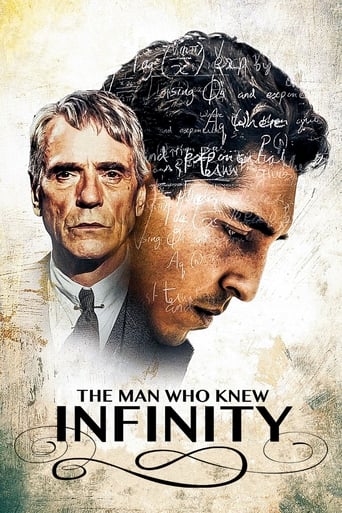
- Genre: Drama, History
- Director: Matt Brown
- Year: 2016
- Runtime: 1h 48m
- Language: English (EN)
- TMDB Rating: ⭐ 7.2/10
Movie Overview
In 1914 Madras, Srinivasa Ramanujan (Dev Patel) scribbles equations in the dust, convinced his work matters even as local scholars dismiss him. What stayed with me after the credits is how the film makes you feel the weight of those chalk marks—each one a gamble that someone, somewhere will understand them.
When a letter reaches Cambridge professor G.H. Hardy (Jeremy Irons), the rigid academic recognizes genius in Ramanujan's unproven theorems. But getting him to England requires bending colonial bureaucracy and Ramanujan's own devout Hindu wife's fears. I wasn't expecting much from the 'fish out of water' setup, but the racism Ramanujan faces at Trinity College cuts deeper than the usual period drama slights.
The core conflict isn't about solving equations—it's about proving their validity to a system that demands Western rigor. Hardy insists on proofs; Ramanujan claims his formulas come as divine visions. Their clashing worldviews play out in cramped offices and wartime ration lines, where the real math happens between bites of stale bread.
That final notebook scene still gets me.
Direction & Cinematography
Matt Brown's direction is workmanlike but purposeful. He frames Ramanujan's early scenes in Madras with a golden haze, then drains the palette to Cambridge grays—a obvious but effective visual shorthand for cultural dislocation. What surprised me most was how he stages mathematical debates like boxing matches, with Hardy and Ramanujan circling tables stacked with papers.
But the film's best-directed moment comes early: Ramanujan kneeling at his wife's feet before leaving for England, both their faces half-shadowed by a flickering oil lamp. No words about fear or love—just fingers brushing a chalk-stained palm.
Pacing stumbles in the second act when wartime subplots intrude. I kept waiting for the film to dive deeper into Ramanujan's health crisis, but it glosses over his physical decline in favor of more equation montages.
Cast & Performances
Dev Patel makes Ramanujan's genius tactile—watch how his fingers twitch when denied chalk, like a musician deprived of an instrument. His performance peaks during a chapel scene where he silently calculates the number of bricks in the archway instead of praying. That's the whole character in one glance.
Jeremy Irons' Hardy is all stiff collars and sharper cheekbones, but he finds vulnerability in unexpected places. There's a blink-and-you-miss-it moment when Hardy smiles at a joke—then immediately schools his face back to sternness. It's the first clue this isn't just another stuffy mentor role.
Toby Jones as Littlewood and Stephen Fry as a bureaucrat feel underused. Fry's cameo as Sir Francis Spring mostly involves delivering exposition while fanning himself with paperwork. A wasted opportunity.
Character Psychology
Ramanujan wants recognition for his work, but what he needs is validation of his entire way of thinking. The tragedy is that Cambridge gives him the first while systematically eroding the second.
Hardy, meanwhile, needs Ramanujan to stay an exotic genius—until the day the younger man coughs blood on a theorem. Then he's forced to see the human cost of 'pure' mathematics.
Themes & Emotional Depth
This is really a film about translation—not just of formulas, but of entire worldviews. Ramanujan's notebooks become a battleground between intuition and rigor, colonialism and tradition. The most telling moment comes when Hardy admits he'll never understand how Ramanujan's mind works, only that it does.
What stayed with me is the film's quiet argument that some truths can't be proven, only believed. Ramanujan's final letter to Hardy lands this point with devastating simplicity.
Memorable Scenes & Dialogue
1) The 'taxi number' scene: Hardy mentions riding cab number 1729, calling it dull. Ramanujan instantly replies it's the smallest number expressible as two cubes in two different ways. Patel delivers the line like it's obvious, while Irons' face cycles from shock to delight. Perfect character revelation.
2) Ramanujan's wife Janaki (Devika Bhise) measuring rice portions alone in Madras, her sari growing looser as war rations tighten. No dialogue—just a slow dolly shot that says everything about sacrifice.
The Ending — Does It Deliver?
The ending works precisely because it's not triumphant. Ramanujan's return to India and final letters to Hardy feel bittersweet—the math survives, but the man doesn't. I'll admit I expected a deathbed reconciliation scene that never came.
What surprised me was the last shot: Hardy alone at Ramanujan's desk, staring at the now-empty chair. It's a quieter, more honest conclusion than the standing ovation the genre usually demands.
What Works
The central partnership feels authentic because both actors commit to their roles' contradictions. Patel shows genius without making Ramanujan a saint, and Irons lets Hardy's icy exterior crack at just the right moments. Their final confrontation over 'proofs vs. intuition' in the rain-soaked courtyard is the film's emotional apex. Also noteworthy: the restrained score by Coby Brown, which avoids swelling strings in favor of sparse piano motifs that mirror mathematical structures.
Honest Criticism
The wartime subplot with Ramanujan's vegetarian struggles feels tacked on, resolving too neatly when Hardy miraculously finds him lentils. Janaki's storyline in India never develops beyond dutiful wife tropes—a shame, since historical accounts suggest she was more assertive. And that dream sequence with Ramanujan's goddess? It lands with a thud, disrupting the film's grounded tone.
How It Compares
It's more focused than 'A Beautiful Mind' but lacks the visual daring of 'The Theory of Everything'. Where it wins is in avoiding biopic clichés—there's no villainous rival, no saccharine romance. The math itself is the antagonist.
Fans of 'Hidden Figures' might miss the ensemble energy here, but Patel and Irons' duet compensates with nuance.
Legacy & Cultural Impact
The film grossed a modest $12 million against its $10 million budget, but found a second life on streaming. It won the Audience Award at the Zurich Film Festival, though awards buzz faded quickly.
Historians note it takes liberties with timelines (Ramanujan's tuberculosis diagnosis came later in reality), but captures the essence of his mathematical rebellion.
Behind the Scenes
- Dev Patel spent months studying Ramanujan's notebooks with a math coach, but admitted most of it went over his head.
- The real Hardy refused to attend Ramanujan's funeral, a fact the film omits—likely to preserve their bond's cinematic purity.
- The chapel scene where Ramanujan counts bricks was Patel's idea, inspired by accounts of the real man's obsessive quantification.
Who Should Watch It?
History buffs and math enthusiasts will appreciate the meticulous period detail and equation-heavy dialogue. Viewers who loved 'The Imitation Game' for its cerebral battles will find similar pleasures here.
But anyone seeking action or romance should steer clear—this is a film where the biggest set piece is two men arguing about prime numbers.
Final Verdict
At its best, 'The Man Who Knew Infinity' transcends the biopic formula by treating mathematics as emotional language. I'm giving it an 8.2 for Patel and Irons' performances alone—they turn abstract concepts into palpable yearning. The script stumbles when it strays from their partnership, but the core story earns its poignancy. Watch it for the scene where Hardy realizes 1729 isn't a dull number after all.
More details, ratings, and cast information on IMDb, TMDB, Wikipedia. YouTube